+201007892200WhatsAppع

Insect and rodent control services

All services

Not sure what the pest is? Send a photo or a short description on WhatsApp and we will tell you what it is and how to treat it.

Elalmanya BiologyHomes and businessesSame day, any governorate

Termite control: we cut off their route from the soil before we treat the wood

The termites you find in a door frame come from a colony that lives in the soil, and they reach the wood through thin mud tubes. That is why spraying the wood on its own only kills the termites inside it. Our work starts with an inspection that finds their way in, followed by a soil barrier or a bait that reaches the colony.

  • Mud tubes
  • Hollow wood
  • Barriers and baits
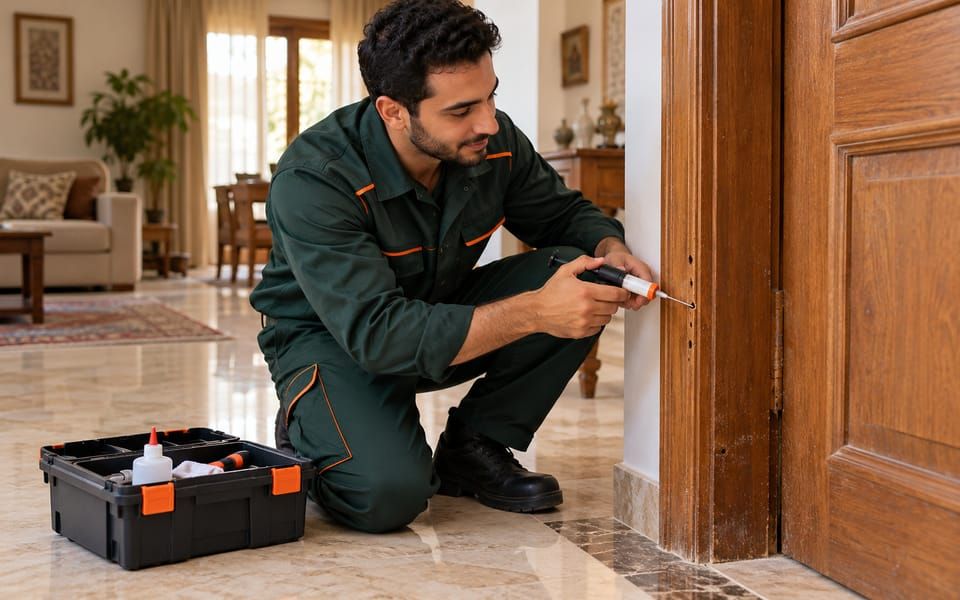
Illustrative photo of a technician treating holes in a wooden door frame inside an apartment

In short

Termite control starts by inspecting the walls, foundations and woodwork to find where termites are active and how they get in from the soil. Then we choose a liquid barrier in the soil around the building, bait stations whose bait they carry back to the colony, or both. We follow up until activity stops, since baits can take months.

  • We tell termites apart from woodworm
  • We inspect walls, foundations and woodwork
  • Treatment based on where they are and how they get in
  • We find the source before treating
  • Cost explained before the visit
  • Safety instructions first
  • Follow-up when your case needs it
  • Homes, offices and restaurants

Signs

Signs of termites in your house

You rarely see termites themselves, because they live inside the soil, the wood and their mud tubes. What you usually find is the trace they leave: a tube on the wall, hollow wood, or wings dropped near a window. If you spot one, photograph it, send it to us, and leave it alone until the technician sees it.

  1. Mud tubes on walls and foundations

    Thin lines of mud about the width of a pencil, running up from the ground over a foundation, a wall or the side of a door frame. Termites build them from soil, saliva and bits of wood, and travel inside them. Break off a piece and you may find pale insects. An empty tube does not mean the infestation is over.

  2. Wood that sounds hollow

    Tap a door frame, the parquet, or the foot of a wardrobe that sits on the floor, or press it with the tip of a screwdriver. If it sounds hollow or the screwdriver sinks in easily, the wood may be eaten inside while its surface still looks fine. Infested wood is hollowed out along the grain and has crumbs of dried mud inside.

  3. Wings dropped near windows

    On a warm day, often after rain, winged insects come out all at once and gather at windows and doors, drawn to the light. Then they shed their wings, so you find clear wings of equal length on the windowsill or the floor. Seeing them inside the house is a strong sign of an infestation close by.

  4. Small holes in drywall and plaster

    Termites sometimes make small holes in drywall or plaster, with crumbs of mud around each hole. You may also find wood that has turned dark or swollen, or with a surface so thin that your finger goes through it when you press.

  5. Pale, soft insects inside the wood

    If you open a piece of infested wood and find small pale insects with soft bodies and no wings, those are workers. Finding them inside the wood means the infestation is active right now, not an old trace left from years ago.

  6. Found one of these signs? Take a photo and send it to us, and we will tell you whether it is termites or something else before any visit.

    Send the photo

How do termites reach the wood?

The termites that damage homes, which many people in Egypt call white ants, live in a colony under the ground, in the soil or close to it. The colony has pale, soft, wingless workers, soldiers with bigger heads, and a queen that lays the eggs. The workers are the ones that eat wood. They reach it from the soil through mud tubes they build themselves, so they can stay in damp, hidden conditions the whole way.

A tube can climb the outside of a foundation, or run behind plaster and cladding that reaches the ground, where you never see it. Once it reaches wood, the termites eat the softer layers and leave the harder ones, so the wood is hollowed out along the grain while its surface stays intact. That is why many infestations go unnoticed for years, until a door threshold cracks underfoot, the parquet sinks, or a built-in wardrobe starts to wobble.

Anything that contains cellulose can be eaten: wood, cardboard, paper, and books stored on the floor of a damp basement.

Termites in Egypt

A study from Assiut University, published in 2015 in the Journal of Plant Protection Research, reports 8 species of subterranean termites in Egypt, 4 of them in the genus Psammotermes, including the sand termite. The same study says subterranean termites are most widespread in the arid and semi-arid parts of Upper Egypt, and that the sand termite is a major pest in the New Valley governorate.

These termites prefer warm, damp places, and the sand termite can do serious damage to unprotected buildings, to wood and to anything made of cellulose. You will find warmth and damp in plenty of homes in every governorate: a bathroom leaking into a wall, a garden watered right up against the foundation, or a closed basement with no ventilation.

Termites, ants or woodworm?

Many people call any insect in wood “woodworm” and any flying insect a “flying ant”. The treatments are completely different, though, so look at what the insect left behind:

  • Mud tubes, and hollow wood with mud inside: subterranean termites coming up from the soil.
  • Small, hard pellets with flat sides, piled under a hole in the wood: droppings of another kind of termite, the drywood termite, which lives in dry wood and never needs to reach the soil.
  • Small round holes and fine powder like flour: woodworm, which needs a different treatment that gets inside the wood. See our woodworm treatment page.
  • A flying insect with a narrow waist and longer front wings: an ordinary ant, not a termite.

If you’re not sure, take a close-up photo of the insect or the damage next to a coin or a pen so the size is clear, and send it on WhatsApp. That photo can save you a visit for the wrong insect. Our guide on woodworm vs termites goes through the differences in more detail.

When should you call a termite control company?

Call if you find a mud tube on a foundation or a wall, flying insects indoors followed by wings on the windowsill, or wood that sounds hollow in a door frame or the parquet. The same applies if you are buying or renovating an older house with a lot of woodwork, because a termite inspection before installation is easier than lifting the parquet afterward.

Until the technician arrives, leave the tubes as they are and don’t spray them, fix any water leak you know about, and move firewood, cardboard and old timber away from the walls. The damage keeps growing inside the wood without showing on the outside, and every month of delay can mean more wood to replace. Call or WhatsApp +201007892200, or see the other ways to reach us on our contact page.

Why it comes back

Why won't spraying termites with bug spray solve the problem?

What you see in the wood is a small part of a colony living in the soil, possibly deep under the house. A spray can or kerosene kills only the insects it touches, and the workers keep coming the same way. To stop them you need a barrier at the soil, or a bait that reaches the colony itself.

  1. The colony isn't in the wood

    Subterranean termites keep their colony in the soil or close to it, sometimes far below the surface. For them, the wood is a place to feed, and the workers travel back and forth between it and the colony inside their tunnels.

  2. Surface spraying doesn't reach them

    Spraying the face of the wood or the wall doesn't get into the galleries the termites have dug through the wood, and it doesn't reach the soil under the tiles or behind the wall. The insects inside carry on working while you think the problem is solved.

  3. Damp keeps drawing them in

    Termites need moisture. A pipe dripping inside a wall, wood touching the garden soil, or water pooling next to the foundation all keep the place attractive to them, even after spraying. That is why fixing leaks is part of the treatment.

Treatment

How our termite treatment works, step by step

The work follows 5 steps, starting with photos and questions on WhatsApp before the visit. We choose the treatment after the inspection, not before, because a soil barrier and baits suit different conditions, and sometimes we use both. Before we begin, we tell you what will be done, where, and what we need from you.

  1. Photos and questions before the visit

    We ask exactly where the signs are, how long they have been there, whether the place is on the ground floor or has a garden or basement, and whether there is a water leak nearby. A clear photo of a mud tube or of the fallen wings makes a big difference in planning the work from the start.

  2. Inspecting foundations and woodwork

    The technician checks the lower part of the walls, door and window frames, parquet, built-in wardrobes and wooden stairs, plus the basement and garden if you have them. Tapping and probing the wood shows which parts are hollow and where the termites are active now.

  3. A soil barrier or bait stations

    If we can reach the soil around the building, we lay a liquid barrier by trenching or injecting, and termites that pass through it die. If digging is difficult, or we need to reach the colony itself, we place bait stations in the ground or over active tubes inside the house. Sometimes we use both methods together.

  4. Treating or replacing the wood

    Wood the termites have reached is treated in place if it is still solid. Wood that has been hollowed out and weakened, such as a door threshold or the eaten foot of a wardrobe, is better replaced with sound wood after the treatment, and fitted so it doesn't touch the floor or the soil.

  5. Follow-up until the activity stops

    Termites can take weeks to find the bait, and months more before the activity stops. So we check the stations and the tubes at intervals we set on the first visit, and we ask you to tell us if a new tube or new wings appear.

Ready for the first step? Tell us what you saw.

Safety

Is termite treatment safe for children and pets?

Termite products vary, many of them are toxic, and some go into the soil around the house or under the tiles. So before the visit we ask about children, pregnancy and pets, and about any well or water tank nearby. We also tell you when you can go back in and how to handle the treated soil.

  • Children and pregnancy

    Tell us on the first call. When you can go back into treated rooms depends on the product and how it is applied, and children should stay away from dug areas and treated soil until the technician says it is fine.

  • Pets and birds

    Take cats and dogs out of the place during the work, and keep them from digging in the treated soil around the house. If you keep chickens or pigeons in the garden or on the roof, tell us so we can plan around them.

  • Wells and water tanks

    If there is a well or an underground water tank near the building, tell us before the visit. Products applied to the soil can reach the water if they are put in the wrong place, and that changes where the barrier goes and how we treat.

  • Ask about the product

    You have the right to know the product's name and details before the work starts. And if someone knocks on your door offering to inspect or spray when you didn't ask, get a second opinion before you agree.

Who it is for

Termite control for homes, villas and warehouses

Termites look for wood and moisture close to the soil, so they usually start on ground floors, in villas with gardens, in older houses with a lot of woodwork, and in warehouses. The size of the inspection varies from one place to another, but the aim stays the same: find their way in from the ground and close it.

Homes and apartments

At home, the damage usually shows in a door frame, a built-in wardrobe or parquet close to the floor, or near the bathroom and kitchen if there is damp. Send us a photo of the sign and where it is, tell us which floor you live on, and we'll tell you the next step before the technician comes.

Send details of your home

Businesses and offices

Warehouses, factories, hotels and buildings with a lot of wood, or with cardboard and paper stored on the floor, need a wider inspection of foundations, floors and storage areas. We draw up a plan with the barrier or bait station locations and a follow-up schedule, and we show the people in charge how to spot tubes and wings early.

Ask for a business quote

Price

What sets the price of termite control?

No single price fits every case. An apartment with one infested room is not the same as a whole apartment, and a home is not the same as a business. The cost depends on these four factors, and we explain it in detail before you confirm the booking, with no surprise charges after the visit.

  1. Size and type of placeA 90-square-meter apartment is not the same job as a villa with a garden, and a restaurant is not the same as a warehouse.
  2. Type of pestEach pest needs its own product and method. Gel bait for cockroaches, bait stations for rats and mice, and wood injection for woodworm.
  3. How far it has spreadA first sighting a week ago is different from an infestation that has been there for months. That is why we ask for photos and signs.
  4. How many visits the case needsSome cases need a follow-up or an extra visit. We decide that after checking which insects or rodents are involved and how far they have spread.

Ask for the quote to show:

  • Inspection and finding the source
  • The products used and their details
  • Number of visits and the follow-up needed
  • Terms and length of any guarantee, if there is one
  • How we record what was done on the visit

Coverage

Termite control in every governorate, same day

We cover all 27 governorates of Egypt with same-day visits. Send your area and the problem on WhatsApp or call us, and we will set a visit time for your home or business. The groups below show the main cities and districts in each region we reach.

  • Greater CairoCairo, Giza and Qalyubia, including Nasr City, New Cairo (Fifth Settlement), Rehab City, El Shorouk, Madinaty, Maadi, Heliopolis, Helwan, 6th of October, Sheikh Zayed and Mohandessin
  • Alexandria and the CoastAlexandria, Beheira, Matrouh and the North Coast
  • The DeltaGharbia, Monufia, Dakahlia, Sharqia, Kafr El Sheikh and Damietta
  • Canal Cities and SinaiPort Said, Ismailia, Suez, North Sinai and South Sinai
  • Upper EgyptFaiyum, Beni Suef, Minya, Asyut, Sohag, Qena, Luxor and Aswan
  • Red Sea and New ValleyRed Sea and New Valley
Send your area and book today

Questions

Common questions about termites

These are the questions people in Egypt ask most about termites, with answers from our daily work. If yours is not here, type it in the box below. It lands in our WhatsApp, and one of the team replies about your exact situation.

How do I get rid of termites in my house?

Cut off their route from the soil, either with a liquid barrier in the soil around the building or with bait stations that reach the colony. Spraying the wood alone only kills the termites you can see. Meanwhile, fix any water leak and keep wood and cardboard off the floor and away from the walls.

What is the best termite killer?

No single product suits every case. The choice depends on the treatment method: a product for a soil barrier, a slow-acting bait that termites carry back to the colony, or a treatment for the wood itself. Most of these products are toxic if misused, and they need a trained technician to put the right amount in the right place.

Why do termites show up in a house?

The usual cause is moisture close to wood, such as a pipe dripping inside a wall or water pooling next to the foundation. Wood in contact with the soil, piles of firewood or clutter next to the house, and cracks in the foundation and around pipes also give them a way from the soil to the inside.

What do flying termites mean?

They are males and females leaving to start new colonies, and they don't eat wood. Indoors they die within about a day, so sweep them up or vacuum them. But seeing them inside usually means there is an infestation nearby, so keep a few insects or wings in a bag for us to look at.

How do I tell termites from flying ants?

A termite has a broad waist with no pinch, straight antennae that look like a string of beads, and 4 wings of equal length. An ant has a narrow, pinched waist, elbowed antennae, and front wings longer than the back ones. A close-up photo of the insect is enough for us to tell which one you have.

How do I tell termites from woodworm?

Woodworm leaves small round holes in the surface of the wood, with fine powder like flour underneath. Termites that come from the soil don't leave that powder. The wood is hollowed out inside with crumbs of mud in it, and there are often mud tubes nearby. The difference changes the whole treatment.

Does kerosene or salt kill termites?

It may kill the insects it touches, but it doesn't reach the colony in the soil, so the activity comes back along the same route. Kerosene is also flammable, and spraying it on the woodwork in your home is dangerous. If you see tubes or eaten wood, photograph them and send them to us instead of experimenting on your woodwork.

Do I need to replace wood that termites have eaten?

Not always. Wood that is still solid can be treated and stay where it is. Wood that is hollow and weak, such as a threshold, a door frame or the foot of a wardrobe, is better replaced after treatment, and the new wood should not touch the floor. Replacing wood without treating the source just gives termites fresh wood to eat.

Not sure where to start? Tell us the problem and we'll plan the next step with you.

+201007892200
Browsing on a computer?
Scan the code and call us from your phone.